20 October 2014

Flinders Quartet: Over a skinny latté IV

Richard Gubbins and Peter Kingsbury
ANAM and St Michael’s Church
9 May 2014, 6 July 2014

The fourth in a series of interviews about Flinders Quartet.
First published in Flinders Quartet:October update 2014

A pair of old friends, both with a long-standing love of music, agreed to commission Paul Dean to write the piece for Flinders Quartet. They discussed why they are doing it.
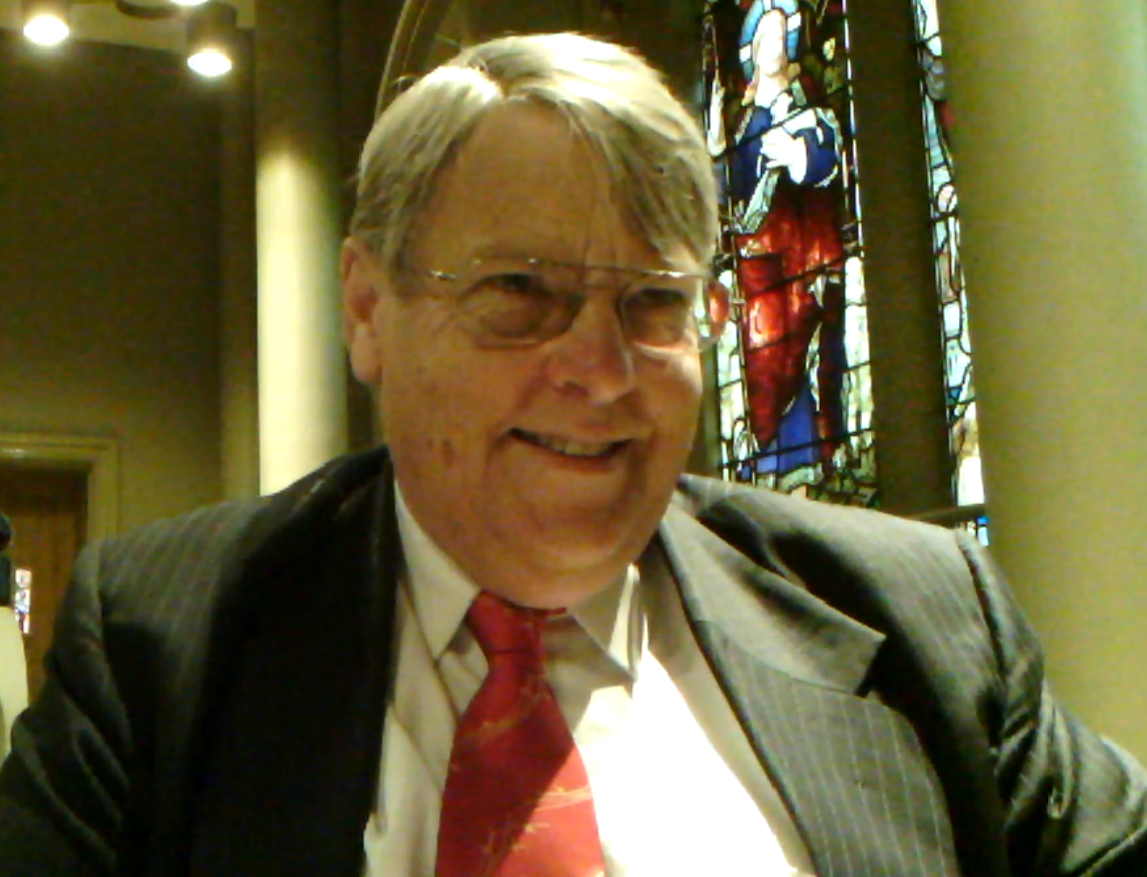
 Twenty years ago Andrew Ford on Classic FM talked about the idea of people forming a group to commission compositions. That idea stuck in Richard’s mind until he was able to commission Calvin Bowman’s The Curly Pyjama Letters for Flinders Quartet. The Paul Dean string quartet is a larger scale commission that emerged from a lunch with Paul, Richard and Richard’s dentist, Peter Kingsbury. ‘It involved an inheritance from my mother’ Richard said, ‘and I have burnt all that.’

Peter Kingsbury

For Peter, commissioning music is not about leaving a memorium; nobody remembers the sponsor. His motivation is about fostering an Australian idiom – how we as Australians see music as part of culture. ‘There are lots of wonderful new composers that need support,’ he says. ‘They don’t write for nothing. Mozart found out to his great horror that we die if we don’t get enough sustenance.’

Richard says he was far too slack to have learned an instrument. ‘I had the opportunity as a child. My parents acquired a piano from Allen’s on hire-purchase but it had to be returned.’ He sang first bass with Melbourne Chorale for 15 years and he loves the march in Beethoven’s Ninth because of its lovely tessitura. He thinks it is great fun to sing, and exhilarating. He loves Vaughan Williams’ Sea symphony. ‘It’s beautiful. It starts off with “the sea itself” and you feel the waves of sound.’ ‘My taste is catholic’ he says,’ but others might say I’m just a prostitute – a musical prostitute; I don’t understand most contemporary music.

Richard Gubbins

Peter used to play, very badly, the recorder in third grade at Cheltenham East State School. ‘I gave up because I couldn’t get past ‘Merrily, we roll along.’

For him, a commission is not about fame or immortality. It’s about trying to say, “this is how Australia was and how Paul Dean interpreted Australia and how Flinders Quartet interpreted Australia at the beginning of the 21st century”. So Paul has artistic carte blanche.

Peter sums it up, ‘it should speak to my emotions otherwise I don’t think the piece of music will survive’.

09 October 2014

Victorian Opera: The Play of Herod

Victorian Opera
Newman College
Friday 2 October 2014

Newman College chapel is about as far removed from The Big Opera Theatres as you can get. The Play of Herod is about as far from The Two Big Money Spinners – Verdi and Puccini – as you can get. For this production they both – the space and the opera – worked and worked spectacularly well.

Victorian Youth Opera The Play of Herod Nativity

The hard stone walls of the long, narrow, high ceilinged chapel loved the trombones and trumpets (it really was a day for trombones). The walls loved Elizabeth Barrow’s assertive Archangel. They also loved the grand organ, the panic-stricken piano and glockenspiel. They loved the divided voices and orchestra – part at the front, part high in the choir loft at the back – and surrounded us with powerful (in every sense of the word) sound that placed us firmly in the centre of The Play.

The Play of Herod is the gutsy, risk-taking, iconoclastic stuff of the sort that is giving VO a valuable reputation as being as far from Sniffy North Shore opera practice as it could get. It’s as if The Play was designed to consume money (but not much) not make it; the chapel holds only a few hundred people. If you want to mount extravagant AO-type sets you need to pander to the matrons whose hubbies hold the cheque book. If your set consists of a red cloth on a stick (to hide the slaughter of innocents) you can ignore the need to find funds sufficient to re-run Aida with elephants and mount something with style and class. We got both: style and class.

The mostly student-age voices from Victorian Youth Opera were superb (or superbly cast) with the magi – including a stunning bass – at the top of the list. Jacob Lawrence’s tenor suited the proto-evil Archelaus as well as it suits his usual Scots Church repertoire and Shajeda Kalitzki-Abedin gave us a controlled, agonising Rachel. All the kids could sing and they sang well, most superbly.

Victorian Youth Opera The Play of Herod.
Jacob Lawrence (Archelaus) Kiran Rajasingam (Herod)
 But for my money – and the tickets really were far too cheap for 75 minutes of excellent music-making – the star performance was Richard Mills’ score: its harmonic invention and its orchestration. Dr Mills seemed to be able to refer back to the 12th century Fleury manuscript – the horrific mediaeval tale – without the load of romantic agony we’re used to in 19th century Italian opera. There was agony but it was controlled. The magic was his orchestration and his genius was out in front in this work: his gentle pastoral treble recorder (a leitmotif?) at one end and his magnificent brass at the other with panic-stricken piano running somewhere in the middle. It was restrained, powerful emotion reminiscent of Benjamin Britten in harmony and control.

Expensive sets? Who needs ‘em? When the score, the orchestration and the singing are right, the production works.

29 June 2014

Victorian Opera: Hansel and Gretel

Victorian Opera
Arts Centre Melbourne
Saturday 21 June 2014

This Hansel and Gretel had been subject to a celestial staffing efficiency dividend. The 14 non-singing angels had been reduced to three and asked to double as spell-bound children where they did sing – like angels. The sets budget was measured in dollars rather than Met-style millions – and most of that was gobbled up by liquorice allsorts for the gingerbread house. The 13-strong pit orchestra had been herded into the back corner of the tiny stage where they peered out from behind the mini -flats. The oven, into which the witch was propelled with a swift kick in the arse, was a break-away cloth painted with angry red flames. It was 100% make-believe on a shoestring.

The Sandman: superb!
Image courtesy of Victorian Opera https://www.facebook.com/media/set/?set=a.10152325526789219.1073741830.127956549218&type=1

The production worked for just that reason: ‘suspend belief, it’s a fairy tale’. And the kids did just that; if they were half-smart, so did the grannies.

The other factor, that which may have escaped the grandchildren but was none-the-less critical to the success of this production, was that the music production was high-standard professional.

The six strings, five woods and two brass were tuned to a razor edge even before the oboe’s A. The orchestra was essential to the colour of this opera and this little band provided it. The bassoon, in particular, was splendid: rich and mellow and with just hints of menace. The singers were clearly confident that Fabian Russell’s band would give them the bedrock they could rely on.

Sibling rivalry - German-style
Image courtesy of Victorian Opera https://www.facebook.com/media/set/?set=a.10152325526789219.1073741830.127956549218&type=1

The singers themselves were immediate-past or present Master of Music students – a testament to their selection and the quality of work they’d got through in less than six months. They were superb!

As Sandman (dressed like a Sicilian spiv: that hat!), Michael Petrucelli’s voice had a beautiful, intriguing golden-sand quality that I’d not heard in a tenor-ish voice before. Cristina Russo’s Gretel was simply lovely: innocent and gentle even when she was beating up her brother.  Carlos E. Bárcenas (he’s an old hand now)  was a wonderful transgender(?) witch (certainly he had some pretty interesting boots for a lady!). Elizabeth Lewis and Nathan Lay acted and sang with the assurance and control we've come to expect from these opera singers: people who understand their part, can act it and can sing it. But for my money the stand-out voice was Emma Muir-Smith as Hansel in the lederhosen role. Her singing was just brilliant. Hers (his?) is a voice to watch. And Hänsel und Gretel together with that sensitive, expert orchestra gave us the most beautiful Abendsegen one could imagine; a three-hanky job. The singing was simple, unaffected and genuine.

This was cut down for length and staging but, as have been all VO’s ‘student’ operas/pantos, the quality of the music was never compromised. Sung in German? Still the action was easily followed without surtitles because the acting was spot-on without being melodramatic.

And, as a bonus, the students (they don’t sound student-like or inexperienced) now have a German role on their CV to sell.
Simply brilliant!
Again.

There's no such thing as a free gingerbread house. 
Image courtesy of Victorian Opera https://www.facebook.com/media/set/?set=a.10152325526789219.1073741830.127956549218&type=1

Flinders Quartet: Over a skinny latté III

Shane Chen
Madeline’s at Jells
Jells Park, Wheelers Hill
8 May 2014
The third in a series of interviews with Flinders Quartet players.
First published in Flinders Quartet: June update 2014

Right place, right time – and nearly twelve years of hard work.

‘I was busking in Equitable Place in the city in June 2003; my hair was permed, my punk-style jeans had a big hole in the knee. It was damn cold; not many people on the street. I was playing Fritz Kreisler. She stood there and I thought, “There’s a nice girl. I’d better play well.” It was Silvia, a friend from school in Shenzhen eight years before when we were nine and in the same chamber orchestra. She told me they had this amazing teacher on violin in Melbourne Uni where she was studying cello.

'Nappies and practice, nappies and practice.'
‘In Years 9 and 10 I skipped a lot of school to play basketball, formed a punk band and practised violin. But I ended up with top marks in  Maths (I could count to four) so when I came to Melbourne on 2001 I had got into a double degree – Commerce and Business Systems.’

The amazing teacher was Bill Hennessy and he gave me six lessons but I couldn't handle two degrees, six hours of practice and English language lessons so I dropped Business Systems and Bill’s lessons.

‘Silvia and I got married, I worked in a shipping company and our first daughter (of three) arrived. Silvia at that time was contemplating that I should do something to fulfil my childhood dream. I applied for a part-time graduate diploma in music at Melbourne Uni. My boss gave me leave so it was nappies and study and practice in the garage (8.30pm till 1.30am) and teaching.

'Interpretation is not perfection. Everyone can bring that on.' 


‘But Bill had gone to ANAM so I applied three weeks short of the cut-off age of 27. Our third baby was due on audition day so I had to leave my phone on. Later, Paul (Dean) told me, “We looked at your application: Commerce degree, plays basketball*. What have we got?” I got a scholarship and a bursary. My 2011 recital was Bach G minor sonata (synthetic strings) an Ysaÿe sonata for solo violin and Beethoven Spring sonata in F major.

He got the highest ranking.
Bill was so happy.
*Shane's CV didn't say "plays basketball" but it should have. [SJ]

Following the Dean string quartet II


The Artistic Director’s Office
ANAM
30 April 2014
The second in a series of interviews with Paul Dean.
First published in Flinders Quartet: May update 2014

‘Here at the Academy the world of Bach and the whole idea of counterpoint opened up to me. As a clarinettist you never play Bach. I realised my music was missing this sense of internal struggle – my definition of counterpoint; that sense that the bass line is ripping apart the middle and upper voices.

‘When I’m writing it’s a visual and a physical contact I have with the performers I’m writing it for. (My current) cello piece is being written for Torleif Thedéen and Kathy Selby. The first gesture that became the basis of the first movement I’ve called Turmoil. I physically see Torleif playing.

‘Second there has to be a story. I find it really hard writing music for music’s sake or absolute or abstract music. For me it has to be some sort of internal logic. When it comes to that (Flinders’) string quartet I'm paying homage to a wonderful young violinist. I was a part of his life in a very small way and in essence I feel that visual physical thing in my head that I’m writing it for Flinders and I’ve got this sort of angel involved at the same time. He’s playing one part of it.

‘And the third thing is the specific sound world (the orchestration) that comes from the initial gestures. The opening note is a sound, that (first) G sharp, that I want to sound other-worldly The A comes in on the first violin two or three octaves higher.

Paul Dean, Artistic Director of ANAM

‘For many years I used the same scale – a bit like a blues scale – but I wrote probably some of my best work using only this scale. It was like a security blanket but when I wrote a piece of music it sounded like me.

‘When I started (my Masters) at Melbourne Uni the first thing I talked about with Stuart Greenbaum was the fact that I was going to scrap the scale and it was really scary I have to say.

‘My first piece was a clarinet quintet.
I used all twelve notes.

It was really liberating.’